Cradle of Empires: 3 in a Row
- 4.6
- Rating
- 5.00M
- Installs
- Free
- Price

 Analysis by App-foxy
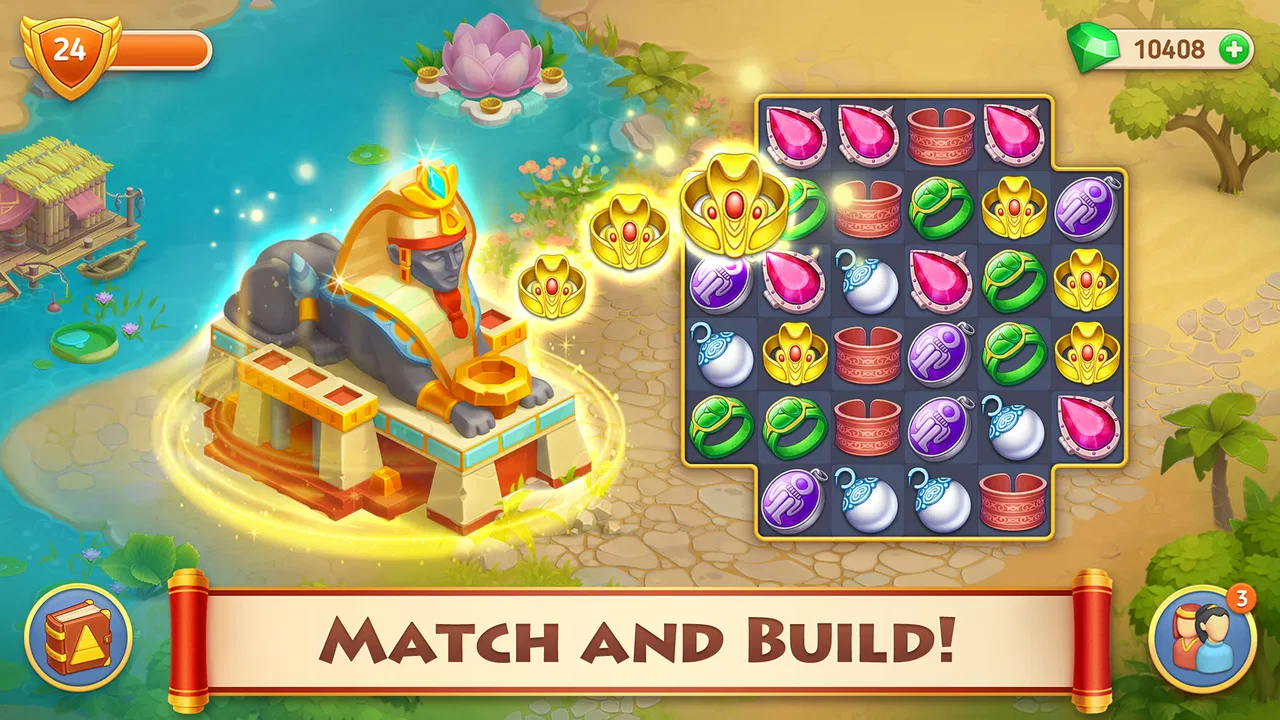
Cradle of Empires: 3 in a Row is the kind of puzzle game I reach for when I want a relaxed session with a little more purpose than simply clearing a board. Its match-three challenges are tied to the restoration of an ancient Egyptian city, so each round feels connected to a larger journey rather than being an isolated score chase. My overall view is positive: it is welcoming, easy to understand, and broad enough to keep a casual player interested, although its energy-driven rhythm and in-app purchase range can make progress feel less comfortable for people who want an entirely uninterrupted experience.
Awem Games Limited has built this as a free puzzle game for Android, with an Everyone age rating. It has reached over five million installs and holds a 4.6 average from roughly 258 thousand ratings, which gives a useful indication of its appeal among mobile puzzle players. The game was released on January 13, 2016, and the current version is 9.4.0. It supports Android 5.0 and later, so it remains accessible on many older devices as well as newer phones.
Why the match-three structure works so well here
The central idea is simple: match pieces in groups to complete objectives, earn resources, and help Nimiru restore the city. That familiar foundation is important because I never need a long tutorial to understand what I am doing. The early stages communicate the basic rules quickly, then gradually ask for more careful choices. This makes the game suitable for someone who has played many match-three titles, but also for a newcomer who wants a gentle introduction to the genre.
You May Also Like

 Blood Strike: 2.5 Anniversary
Blood Strike’s Loadouts Turn Every Drop Into a Tactical Gamble
A close look at Blood Strike’s custom loadouts: how fast access to signature weapons reshapes its battle royale rhythm, rewards preparation, and narrows the gap between fights.

 Pandora - Music & Podcasts
Pandora’s Music Is Easy to Start, but Harder to Recover
Pandora’s strength is its low-effort path from a seed to a station. Its weak spot is how much confidence it asks you to place in connection, setup, and quiet recovery.

 8 Ball Pool
 Is Built on Rivalries, Rematches, and Routine
A close look at the rivalries, rematches, shared routines, and unanswered safety questions that turn a quick pool match into a persistent mobile community.

 Samsung Music
’s Quiet Strength Is Playing What You Already Own
Its reach comes less from spectacle than from dependable access to a personal library. That simplicity is both the app’s strongest retention engine and its ceiling.

 AccuWeather: Weather Radar
AccuWeather Review: A Quick, Clear Forecast for Everyday Decisions
For everyday plans, the best forecast is the one you can understand quickly. AccuWeather makes rain timing, radar, and local conditions easy to act on, with a few trade-offs.

 Hill Climb Racing
Why Hill Climb Racing Still Turns Crashes Into One More Run
A tiny car, a bumpy hill and one more upgrade: Hill Climb Racing keeps resurfacing because its simple chaos makes every near-miss feel personal.
More From Our News Desk
View All News


What gives the experience its identity is the connection between puzzle results and the city-building layer. A successful board is not just a win screen; it contributes to a visible sense of rebuilding. That framing gives me a reason to continue after a difficult level. I am not only trying to beat a board for a higher score. I am working toward a setting that changes as I move forward, which makes individual victories feel more meaningful.
The Egyptian theme also helps the game avoid the completely interchangeable look of many casual puzzle releases. The setting gives the progression a recognizable mood, and Nimiru provides a personal focus for the restoration story. I would not describe the narrative as the main attraction, but it is useful glue between the puzzles. Players who enjoy light adventure framing around familiar mechanics will probably appreciate that balance.
One of the strongest design choices is the way the game encourages short sessions. A player can open it while waiting for transport, take on a few boards during a break, and close it without needing to remember a complicated control scheme. At the same time, the restoration goals create a reason to return later. In my experience, that combination is more effective than a puzzle game that depends purely on endless score improvement.
Small decisions matter more than fast tapping
Although the opening boards are approachable, the better results come from looking at the whole board before making the first move. I found that rushing to clear the most obvious group can remove the chance to create a more useful combination elsewhere. A practical habit is to scan the lower part of the board first, because a move there may cause pieces above to fall and create an unexpected follow-up. This is a small change in play style, but it makes later stages feel more thoughtful.
I also recommend treating special combinations as tools rather than automatic rewards. It is tempting to trigger a powerful move immediately, yet saving it for a crowded section or for an objective that is difficult to reach can be more valuable. The game becomes less about tapping quickly and more about deciding when a move has the greatest effect. That is one of the less obvious strengths of the design: the simple rules leave room for planning.
Another useful approach is to separate the board’s immediate appearance from the actual requirement of the level. If the objective is to clear particular elements, chasing ordinary matches may waste turns. I try to identify which areas are blocking progress and build moves around them, even when that means ignoring an attractive match elsewhere. This mindset is especially helpful for players who are used to solving every board by creating the biggest possible chain.
The restoration layer adds another decision beyond the board itself. When I am moving through the city, I feel more motivated when I set a small rebuilding target instead of treating the entire map as one huge project. Completing one visible improvement at a time keeps the progression satisfying and prevents the larger setting from becoming background decoration. That is a good way to play during brief sessions, because each visit can have a clear purpose.
Where the game creates friction
The main limitation is the familiar stop-and-start structure associated with free mobile puzzle games. A player may want to continue after a difficult stage, but the game’s pacing can encourage waiting or spending rather than playing continuously. That is not unusual for the category, yet it affects the overall feel. If I am looking for a long, uninterrupted puzzle session, this is not the most comfortable choice.
The in-app purchase range runs from $0.49 to $154.99 per item. The game itself is free to download, but that wide range is worth noticing before handing it to a child or allowing purchases on a shared device. The Everyone rating describes the age suitability of the content, not a promise that every player will enjoy the commercial pacing. I would personally use purchase restrictions if a younger family member were playing.
Some players may also find the progression less satisfying when they are focused only on pure puzzle mastery. The city restoration and story framing are meaningful additions, but they can feel like extra layers around the board rather than essential parts of solving it. Someone who wants a minimalist match-three game with no broader progression may prefer a simpler alternative. Here, the surrounding goals are part of the appeal, but they also make the experience feel busier.
The game is not the best fit for people who dislike repetition. Match-three rules are easy to learn, and that accessibility is a strength, but it also means the basic action remains familiar throughout. The challenge comes from objectives, layouts, and resource pressure rather than from learning an entirely new control system. Players who need constant mechanical novelty may lose interest sooner than casual fans of the format.
There is also a difference between playing thoughtfully and playing comfortably. Planning several moves ahead can improve results, but the game’s mobile structure may still make a player feel that an unsuccessful attempt has cost more than just time. I think it works best when approached as a gradual pastime rather than a task that must be completed immediately. That attitude reduces the frustration caused by failed boards and makes the restoration theme more enjoyable.
How it compares with other puzzle choices
Compared with a basic match-three game that focuses only on clearing gems or chasing a score, this title offers more context. The ancient-city setting, Nimiru’s restoration goal, and the sense of rebuilding give me a stronger reason to return. It is a better choice for someone who likes a light adventure layer attached to familiar puzzles.
Compared with a story-heavy adventure game, however, the puzzle board remains firmly in control. The narrative supports the gameplay rather than replacing it. If you want long dialogue scenes, complex character development, or a role-playing system, this will probably feel too light. If you want something that can be understood in seconds and still provides a continuing objective, it is much more suitable.
It also differs from competitive puzzle games that put the emphasis on leaderboards, head-to-head matches, or rapid reactions. My attention here is directed toward completing the current objective and improving the city, not proving that I am faster than another player. That makes it calmer, though perhaps less exciting for anyone who needs direct competition to stay engaged.
Against a premium puzzle game, the trade-off is clearer. A paid alternative may offer a more controlled progression and fewer interruptions, while this free release makes it easier to try without committing money at the start. I would choose this one when I want flexible, casual access and do not mind a progression system shaped by mobile-game pacing. I would choose a premium option when uninterrupted play matters more than the city-building theme.
Who will get the most from it
I think this is a strong fit for casual players who enjoy match-three puzzles but want a reason to keep returning after each board. It is also well suited to people who like restoring places, collecting progress, and watching a setting develop gradually. The Everyone rating makes it broadly approachable, and the controls are simple enough for family members with different levels of gaming experience.
A realistic everyday use case is a short evening break after work or school. I can play a few levels, make a little progress in the city, and put the phone away without needing a long setup. On a slower weekend, I might spend more time planning moves and revisiting the restoration goals. The same game supports both habits, provided I am comfortable with its pauses and gradual rhythm.
It can also work for players who enjoy thinking but do not want a demanding strategy game. The boards reward attention, especially when I stop chasing the first available match and start looking for moves that affect several objectives at once. That gives the game a modest strategic layer without making it intimidating. It is a good middle ground between a completely mindless time-filler and a puzzle that requires extended concentration.
I would be more cautious about recommending it to someone who wants transparent, unlimited progression or who becomes frustrated by waiting. I would also steer away from it for players who prefer one-time purchases and no optional spending structure. In those cases, a premium match-three game or a smaller offline puzzle may be a better fit, even if it lacks the Egyptian restoration setting.
Practical advice before you start
Because the game is free, the easiest way to evaluate it is to approach the first sessions as a test of pacing rather than as a commitment. Notice whether the restoration goals make you curious about the next stage, and pay attention to how you feel when a board does not go your way. If the gradual loop feels rewarding, the game has enough structure to become a regular companion. If the pauses are irritating from the beginning, the extra theme probably will not change your mind.
I would keep notifications under control if the phone allows it. A puzzle game like this is most enjoyable when I open it because I choose to, not because every alert pulls me back into another task. I would also decide in advance whether I am willing to spend anything. That makes the free starting point easier to enjoy and prevents an impulsive purchase from shaping the whole experience.
For better board performance, I try to prioritize moves that open restricted areas, create cascades, or directly address the level’s main requirement. I avoid spending a useful special move simply because it is available. When a stage seems unfair, I pause and look for a different opening rather than repeating the same first move. These habits do not remove the game’s limitations, but they make its puzzle side feel more deliberate.
Android users with version 5.0 or later can run the current release, 9.4.0. Since the game has been available since January 13, 2016, it has had plenty of time to establish its particular blend of match-three play and city restoration. That age is not a drawback by itself; in this case, it means the concept is familiar and well defined rather than experimental.
My final recommendation
My verdict is that Cradle of Empires: 3 in a Row succeeds because it gives a familiar puzzle format a clear destination. The boards are easy to enter but reward patience, while the Egyptian city gives ordinary victories a sense of continuity. I especially like it for short sessions, relaxed planning, and players who enjoy seeing gradual progress build into a larger setting.
Its weaknesses are equally clear. The free-to-play pacing can interrupt momentum, optional purchases cover a very broad range, and the core action may feel repetitive to anyone seeking constant novelty. Those are meaningful limitations, not minor details. I would not recommend it as the first choice for a player demanding unlimited, uninterrupted puzzle play.
For everyone else, I think it is worth trying. The free entry point, accessible controls, and light restoration adventure make it more inviting than a bare score-based puzzler. If you enjoy match-three games with a visible sense of purpose, this is one of the more approachable ways to spend a few spare minutes. Just play it at its own pace, protect yourself from unwanted purchases, and judge it by the satisfaction of steady rebuilding rather than by how quickly you can finish every board.
FAQs for Cradle of Empires: 3 in a Row
01What is Cradle of Empires: 3 in a Row?
Cradle of Empires: 3 in a Row is a match-three puzzle game with a city-building and adventure layer. You complete levels by matching three or more identical pieces, earn resources, and use them to restore an ancient empire. The game combines puzzle challenges, story quests, character interactions, decorations, and progression systems, making it more substantial than a traditional match-three title.
02Is Cradle of Empires: 3 in a Row free to download and play?
Yes, Cradle of Empires: 3 in a Row can generally be downloaded and played for free on supported Android and iOS devices. However, it uses optional in-app purchases for items such as coins, boosters, energy, or other useful resources. Progress is possible without spending money, although some players may encounter waiting periods, limited lives, or difficult levels that make purchases tempting.
03Does the game require an internet connection?
An internet connection may be needed for several features, including downloading updates, synchronizing progress, displaying advertisements, processing purchases, and accessing special events or online rewards. Some puzzle gameplay may work temporarily without a connection, but offline availability can vary by device and game version. For the most reliable experience, it is best to launch the game while connected to Wi-Fi or mobile data.
04Are there advertisements and in-app purchases in the game?
Yes, players should expect advertising and optional in-app purchases in Cradle of Empires: 3 in a Row. Advertisements may appear between activities or be offered in exchange for extra rewards, while purchases can provide currency, boosters, energy, or faster progression. The game can be enjoyed without buying anything, but users who prefer uninterrupted play should review the purchase and parental-control settings before playing.
05Is Cradle of Empires: 3 in a Row suitable for children?
The game is generally suitable for players who enjoy colorful puzzle gameplay, light adventure, and city restoration. It does not focus on realistic violence, but it may include advertising, social features, and optional purchases that require adult supervision for younger users. Parents should check the age rating listed for their region and enable device-level purchase restrictions to prevent accidental spending.
Pros
- Hundreds of match-3 levels provide plenty of content for casual sessions.
- City-building elements give progress beyond simply completing puzzle boards.
- Special boosters help clear difficult layouts and create satisfying combos.
- Bright artwork and animated effects make the game visually appealing.
- Regular tasks and events can add variety to the standard level progression.
Cons
- Later levels can become very challenging without strategic booster use.
- Lives limit continuous play and may require waiting or spending currency.
- Frequent rewards and offers can make the interface feel somewhat busy.
- Progress may feel slow if you avoid optional purchases and resource spending.
- Some levels rely heavily on favorable tile layouts and luck.

Cradle of Empires: 3 in a Row
Gallery